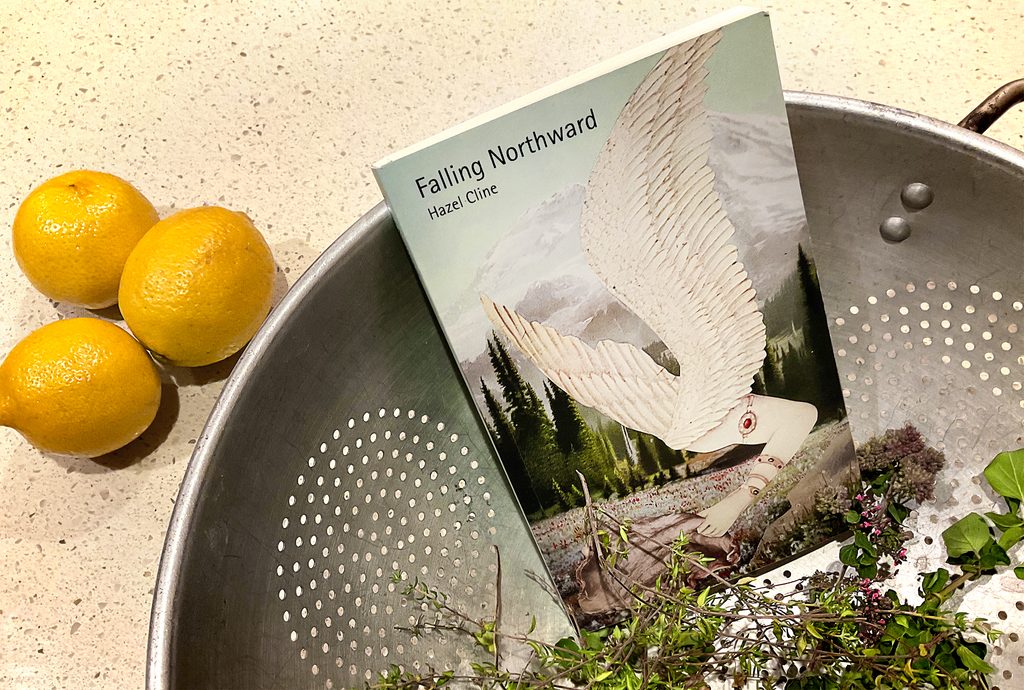
By Hazel Cline
Disarticulated Press, 2026
109pp
Reviewed by Nate
All aboard for Ardenville, homey hamlet of the Arden Valley. With its old-timey hitching posts along Depot Street; and the squabbling old couple who run the general store; and ol’ “Steamy,” replica of the historic locomotive that once chugged through these parts; the Maybury charms of Ardenville may feel familiar. Shoot, they’ll feel downright cozy. Get yourself the best (and only) cuppa coffee in town over at Toasty Beans and say how-do to young Fern behind the counter.
But look a little closer and notice that Ardenville is not what it initially seems. Take the landscapes hung around Toasty Beans, painted by the local dauber, Ms. Posy. At first glance these appear to be your typical homespun portraits of Sunset Ridge, until you notice those giant arachnids perched atop the peaks, god-big and weaving the sky into being. There’s a portal under the general store, too, from which a strange chorus of voices echo. Oh, and the robed members of the Fellowship of the Sacred Sign are back in town celebrating the fall equinox—not all of them will return safely home. On top of it, there are all these birds passing through lately, susurrus, like a secret message in transit.
The word “uncanny” springs to mind. A kind of tension between the familiar and unfamiliar, something that refuses to feel at home in the homey (unheimlich = un-homey). In Falling Northward, there’s a strained distance between the small-town familiar and the otherworldly unfamiliar, making Ardenville a very uncanny place.
Another word might be occult.
From a birds-eye view, Ardenville presents a clear grid. The east-west train line passes through town on one axis and the Babble River runs south along the other. The birds, who not only call out from the trees but appear in old prints and on the covers of books, and even in the descriptions of the characters themselves, in their fluttering and shifting and nesting—the birds, we notice, are quietly heading north. According to this bird-augury, the pendulum has changed directions over the grid of Ardenville, from the workaday east-west of the train line to the northern inevitability of winter.
Hazel Cline has written what I’d call a hedge witch novel: cozy, occult, something to light a candle and drink some tea to. It’s a novel that cares about cycles, equinoxes and their seasons, rituals and animals and instinct.
The brief chapters are each from a different character’s point of view, ranging from the town notables and youths to animals and mysterious entities, and even the Babble River itself. It’s written in short, lapping sentences, often rapt and intimate, like utterances from a trance, and the story is less the unfolding of a plot than a triangulation, via many points of view, of an underlying reality. Maybe it’s better to think of Ardenville and its voices as a single psyche and Falling Northward as a kind of parts work, a glimpse-by-glimpse integration of the northward instinct that secretly rules Ardenville.
I could see Falling Northward on the shelf beside the stories of Leonora Carrington, or Ithell Colquhoun’s Goose of Hermogenes. These Surrealist “fictions” often ask as much of the reader as they do the writer and a Surrealist “novelist” should probably be judged not so much by their craft as the clarity with which they convey material from the Unconscious, the Otherworld, or whatever you want to call that place that pure story comes from.
The title Falling Northward is wordplay. This is a beautifully autumnal book. Initially I was confused by the northward migration of the birds during the fall equinox. Shouldn’t they be heading south? But this is probably the uncanniest irony of the book. At the heart of all the coziness there’s a darkness, which is the instinct of fall, nature’s death fantasy. This backwards instinct exists in all of nature, unconscious but irresistible. It’s backwards from how we generally want to go, in contradiction with our conscious impulses, and yet we go. Without trying, we fall.
Hazel Cline is also creator of the Tarot of Perpetual Time, which I took for a spin over on my personal Substack, if that’s the kind of thing that interests you.
Subscribe to Puzzlegrass for More
Subscribe to Puzzlegrass Online for more reviews of adventurous independently published books and other interesting (we hope) things. And make sure to check your spam for the confirmation email.